

As a researcher in Food and Beverage innovation, it is practically impossible to switch off my sensors for monitoring new products. We are human beings—we eat and drink. Every day. Everywhere. How could we not observe?
We’re in that low-productivity week between holidays, and I decided to enjoy a slow, unhurried coffee at one of my favorite hot spots in the city. Taking advantage of the fact that after the Christmas holidays Buenos Aires empties out completely and the so-called “ciudad de la furia” turns into a “city of peace.” After Christmas, porteños migrate to the coast—Argentine, Uruguayan, and Brazilian—and the city becomes a delight to walk through and explore until early February. Less traffic, less noise, fewer people. An invitation to the pleasure of watching time go by. And so I allowed myself a Domenico de Masi–style morning of pure creative leisure.
I arrived at the café—there were tables available (hallelujah!)—sat down, ordered toast with cottage cheese and an iced flat white. While waiting for my order, I turned on the most complete 360° radar there is: the human gaze.
And what a surprise it was. On the shelves of the café’s mini market, I spotted the packaging of a new product. An Argentine product. With a visual identity that, for a few milliseconds, transported me to memories of what I had registered during my most recent visits to the U.S.
If you’re a regular reader and follow my work and the projects of Fair Food Consulting, you’re probably familiar with our product-launch radar. We closely track consumer trends in food and beverages and the contemporary products that reflect them in the world’s leading cities. Fair Food specializes in the Latin American market, but never stops looking at the global landscape.
So I propose an exercise. I’ll describe the product here, and surely—even without seeing the image—you’ll associate it with a well-known innovation case in the category.
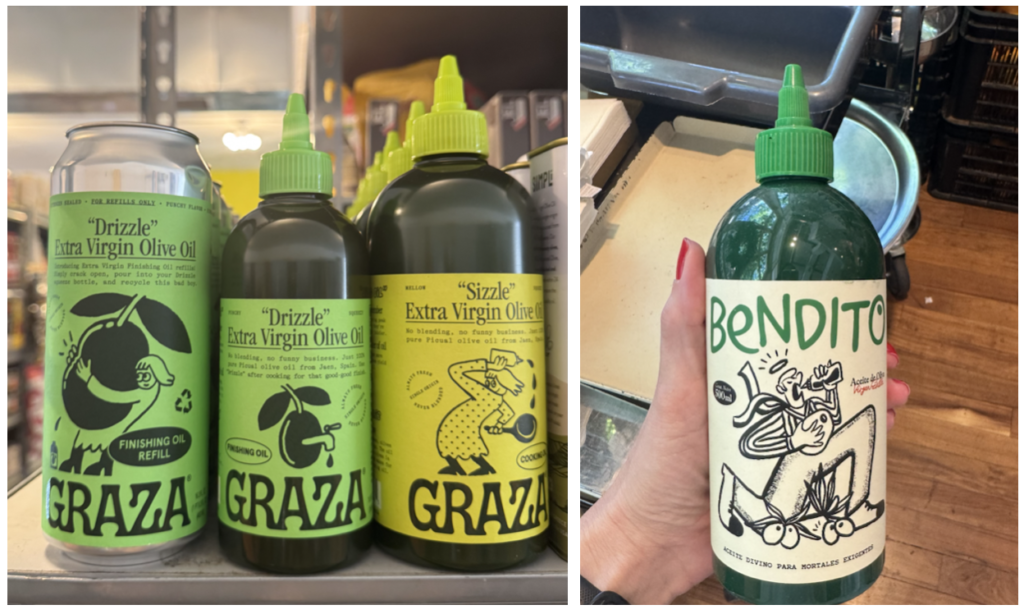
Extra virgin olive oil. In an opaque plastic bottle. Dark green. With a plastic dosing cap with a narrow spout, similar to those used in professional kitchens or on the tables of any snack bar. More clues? A playful visual identity, with monochromatic illustrations (dark color on a light background) of a human figure interacting with an olive. Short naming. Bold, uppercase typography. Ring a bell?
The original version, sitting on the shelf shoulder to shoulder with competing brands, stands out completely from the dominant visual codes of the category and thus achieves what we call “category disruption”. It breaks the mold. It grabs attention. It sparks curiosity. And it marks a before and after in the history of the category—like when Vanish entered the bleach category with its fuchsia pink in a sea of white. It disrupted. And everything else became history.
In the case of olive oil, we’re talking about Graza. Andrew Benin, a young American entrepreneur, launched it in 2021 in Brooklyn, NYC. On a trip to Spain, he tasted superior-quality olive oils, validated his perception with chef Michael Anthony of the Michelin-starred Gramercy Tavern, found partners and investors, and decided to bring it to the U.S. The novelty? Beyond product quality, the packaging. An insight that came in the shower, looking at a Dr. Bronner’s shampoo bottle. Why not make it a squeeze bottle? Boom. Success.
Exponential growth driven by the adoption of a new consumption habit. Over the years, Graza continued innovating, offering olive oil in aluminum cans (like beverage cans) for refilling the squeeze bottle, as well as bag-in-box formats for family sizes—and yes, it eventually had to give in and offer a glass-bottle version for traditional purists.
In 2025, it reached a USD 240M valuation. Bravo, Graza.
Were you familiar with the case?
But going back to the product I saw in the Buenos Aires café… Although everything I described refers to Graza, what I saw was not an imported Graza—it was a copy. Unfortunately, I can’t call it inspiration. It was grotesquely reproduced.
Argentina produces excellent olive oils. I’ve had the opportunity to study the category specifically in this market and visited olive groves on the Zuccardi estates. The category here follows the same well-known codes seen elsewhere: dark glass bottles, aluminum screw caps, sometimes mentioning the olive variety or the blend. Is there room to innovate? There always is—especially in an olive-producing country.
In innovation, there’s a concept called “steal with pride,” which encourages borrowing, adapting, and improving others’ ideas rather than starting from scratch, in order to promote faster growth and creativity—but crucially, it requires acknowledging the source to make it ethical innovation rather than theft. And that’s fine. But there’s a thin line between “steal with pride” and “steal with shame”.
I did a quick scan of the Argentine brand’s social media and found that consumers have already commented on the plagiarism. Consumers travel. And if they don’t travel, social media shows them what they would see if they did. Recently, in one of my marketing classes at the university, I asked my Argentine students if they knew a certain cookie brand that’s a hit in NYC. All of them knew it. None had tasted it. Social media eliminates territorial (and economic) barriers to worldview.
I don’t know the founders of the copycat brand. I’d love to meet them and understand what led them to invest in a project like this. I neither blame nor judge them. I simply bring the reflection. Those of us working with innovation in Latin America often deceive ourselves with the false perception that innovating here means copying what’s done in the Northern Hemisphere. I have many reasons to encourage inspiration from vanguard markets—but not copying. Not to mention the legal issues this can create.
Let’s take ownership of what is ours. Let’s finally leave our colonial syndrome behind. We Latin Americans have more than enough reasons to believe in the potential of our products, our markets, the idiosyncrasies of our culture, and—above all—the richness of our mental model. We can do things differently.
I deeply believe in the potential of Argentina and its local products. The same goes for Brazil and every other Latin American country. And every time Fair Food is called upon to develop a product for this market, I make a point of provoking and reclaiming our Latin American way of being. It’s my duty to bring inspiration and look to vanguard markets—but also to remind us that we are Latin Americans creating products for Latin Americans. And we are fully entitled to propose products that are genuinely rooted in our culture—from concept to product, from formula to packaging, from brand to object of desire.
I leave here the comparative photos for the reader’s consideration. I’ll be attentive to your perceptions.
I’ll end this text—and this year—with an invitation to the community of food and beverage entrepreneurs: shall we innovate in our own style? And if we don’t yet have it clearly defined, shall we create it together? In 2026, Fair Food Consulting will have the great pleasure of continuing to raise this flag. Innovation—from concept to consumer—our own, authorial, Latin American way.
